

How to Use Guided Imagery for Sleep
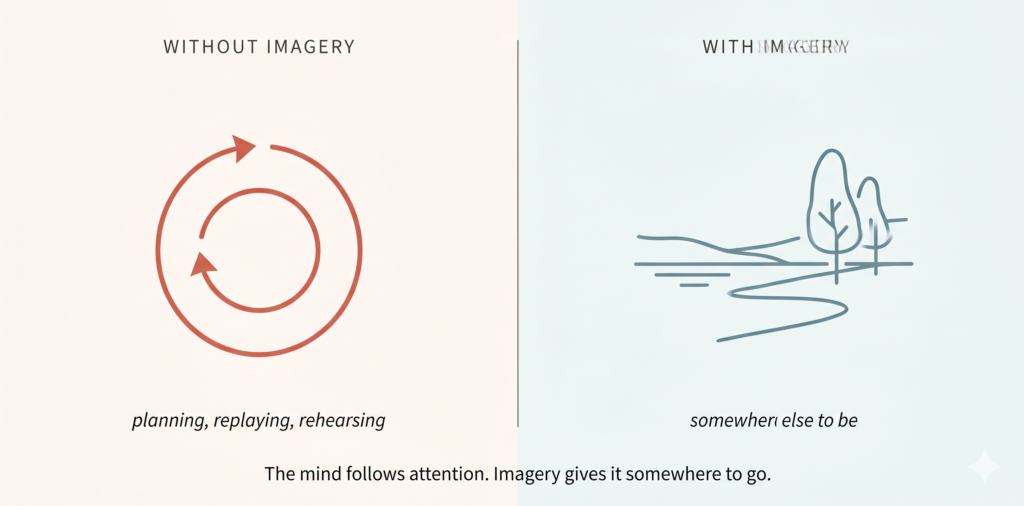
The lights go off and your mind turns on. Not winding down — planning, replaying, rehearsing. You’re exhausted, but something in you won’t stop moving.
This isn’t a willpower problem. The aroused brain doesn’t go quiet on command. What it does do is follow attention — and if you don’t give it something to follow, it picks its own project, usually an unhelpful one.
Guided imagery works on exactly this. A 2013 study published in Sleep Medicine found that adding guided imagery to standard insomnia treatment reduced pre-sleep worry — the cognitive arousal that keeps people awake — compared to baseline. The mechanism isn’t mystical. When you give the mind a vivid, sensory scene to inhabit, it has less room to run the worry loop. You’re not forcing relaxation. You’re occupying the channel.
That distinction matters. Trying to relax is effortful, and effort is arousing. Guided imagery sidesteps that paradox by redirecting rather than suppressing — the mind gets absorbed in building something, and sleep has more room to arrive on its own.
How to practise
The following steps draw from the imagery protocol used in the Sleep Medicine research and from Kaiser Permanente’s clinical guidance on guided imagery practice.
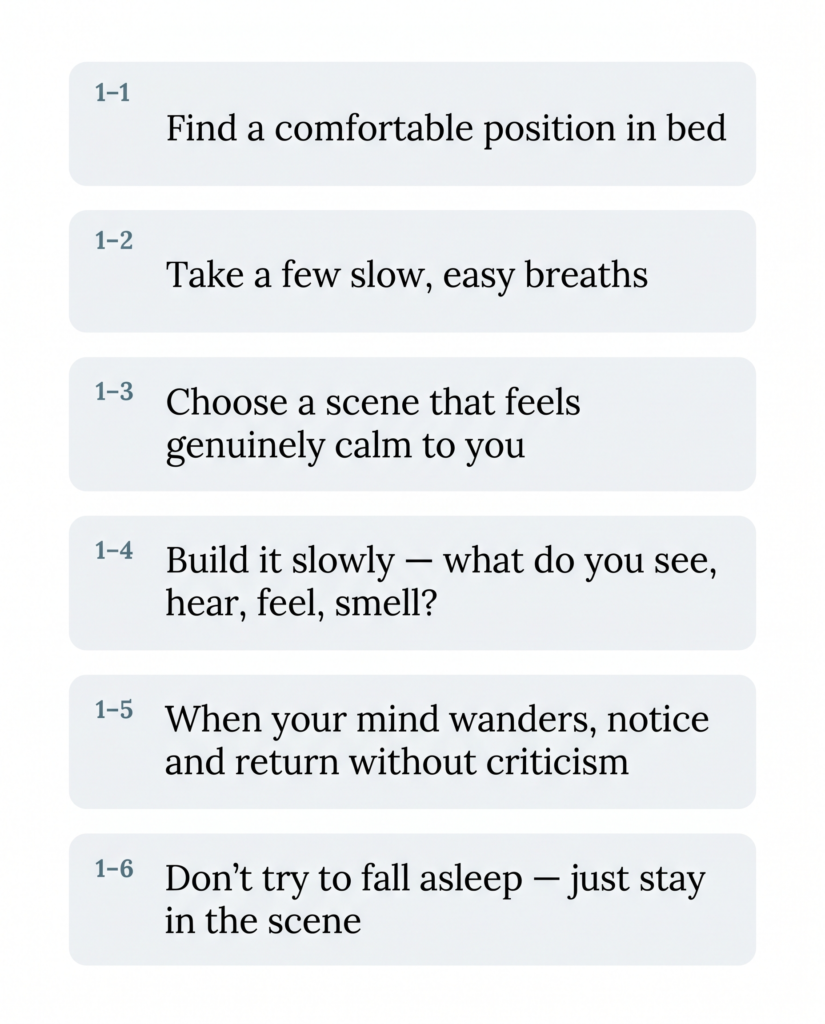
Find a comfortable position. Lying in bed is fine — this is meant to be done as you’re settling in for sleep, not as a separate exercise elsewhere.
Take a few slow breaths first. Not a formal breathing exercise; just a few easy exhales to shift out of the day’s pace.
Choose a scene that feels genuinely calm to you. This is personal. A mountain lake, a quiet garden, a familiar beach at dusk — whatever your mind associates with stillness and safety. If no obvious scene comes to mind, pick somewhere you’ve been that felt unhurried.
Build it slowly using all your senses. What does the light look like? What sounds are present — or absent? What does the air feel like against your skin? Is there a scent? Take your time adding detail. The richness of the scene is what makes it absorbing enough to compete with worry.
When your mind wanders — and it will — notice that it has, and return to the scene without criticism. Wandering isn’t failure. It’s the nature of attention. The practice is the returning, not the uninterrupted staying.
Don’t try to fall asleep. That’s the one instruction that matters most. The goal of imagery is to give your mind somewhere to be. Sleep is more likely to arrive when you’re not chasing it.
A few practical notes
Imagery tends to become more effective with repetition. The Forward et al. study used daily practice over several weeks; participants in the imagery group listened to a 14-minute recording each night before sleep. If the first few attempts feel awkward or produce no obvious effect, that’s normal. The scene gets easier to inhabit once it’s familiar.
If you find it hard to visualize on your own, using a recorded guide is a reasonable starting point. Belleruth Naparstek’s work is probably the most widely used in clinical contexts, and her sleep-specific recording is available through several platforms including Audible and the Kaiser Permanente health library.
Imagery is not a replacement for the behavioural components of CBT-I — sleep restriction, stimulus control, and the rest of what actually resets a dysregulated sleep system. But as a tool for managing the racing mind at lights-out, it has good evidence behind it and a low cost of entry. Worth trying.
The goal isn’t to produce sleep on demand. It’s to stop spending the pre-sleep period in conflict — fighting the mind, monitoring the clock, calculating how many hours remain. Guided imagery gives you somewhere else to be while your body does what it already knows how to do.
If you’re working on persistent insomnia and want support beyond self-directed techniques, I’m available for a free consultation.
Citation: Forward, J. B., Greuter, N. et al. (2013). Pre-sleep worry decrease by adding reading and guided imagery to insomnia treatment. Sleep Medicine, 14(12). https://doi.org/10.1016/j.sleep.2013.09.008